SMM May 21: at the 2021 China International Nickel-Cobalt-Lithium Summit Forum sponsored by SMM Information & Technology Co., Ltd., Xing Xing, Deputy General Manager of Battery Materials Division of Shenzhen Ruisheng Technology Co., Ltd., introduced the application of MVR evaporation crystallization technology in lithium electricity industry. She said that with the rapid growth of the battery industry, prices and demand for major raw materials, including nickel, cobalt and lithium, have risen rapidly in recent years, resulting in an overall shortage of nickel, cobalt and lithium materials. In this context, a large number of new projects are being launched one after another, and raw material manufacturers such as ternary precursors, lithium carbonate, lithium hydroxide, manganese sulfate, cobalt sulfate and nickel sulfate are expanding production to meet the needs of the future market. MVR evaporation crystallization system arises at the historic moment.
A brief introduction to the present situation of Lithium electricity Industry
Environmental protection, energy conservation, emission reduction, sustainability
In the context of the sustained high growth of new energy vehicles, the battery industry continues to be booming, and the battery market has driven the demand for materials to continue to grow.
At the same time, the rapid growth of the industry also brings many problems, mainly reflected in the supply of raw materials. Due to the rapid growth of demand and environmental protection and other factors, the price and demand of major raw materials, including nickel, cobalt and lithium, have risen rapidly in recent years, which has led to a shortage of nickel, cobalt and lithium materials as a whole.
Under the background of this industry, a large number of new projects are being launched one after another, and raw material manufacturers such as ternary precursors, lithium carbonate, lithium hydroxide, manganese sulfate, cobalt sulfate and nickel sulfate are gradually expanding production to meet the needs of the future market.
Application of MVR evaporation Crystallization system in Battery material production
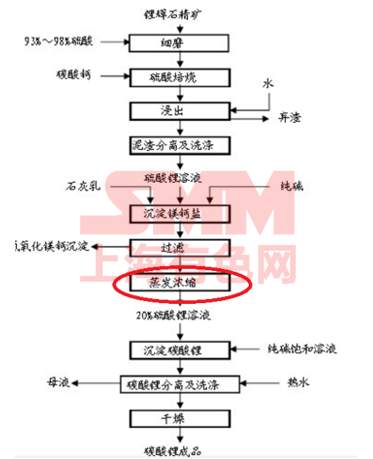
In the production of LiCO3 and LiOH, LiSO4 leached by spodumene acid must be evaporated and concentrated to a certain concentration before it can be used to precipitate LiCO3.
LiOH crude products and LiOH fine products also need to be obtained by evaporation crystallization and secondary evaporation crystallization. Similarly, evaporative crystallization and drying are also the last steps in the production of NiSO4, CoSO4 and MnSO4. (evaporation crystallization of wastewater containing sodium sulfate in ternary precursor material)
The Development History of evaporation Technology
At present, the main evaporator technologies used at home and abroad are multi-stage evaporation, multi-stage flash evaporation and mechanical steam recompression (MVR) evaporation. Due to the rising steam cost, the MVR evaporation technology using secondary steam recompression technology has been greatly welcomed by the majority of users.
Multi-stage evaporation and multi-stage flash technology appeared in the 1950s, while mechanical steam recompression technology (MVR) appeared in the 1980s. 90 years later, due to the vigorous development of frequency converter technology, MVR evaporator has become the most advanced evaporation technology in foreign industries.
MVR mechanical vapor recompression and evaporation
MVR evaporation principle
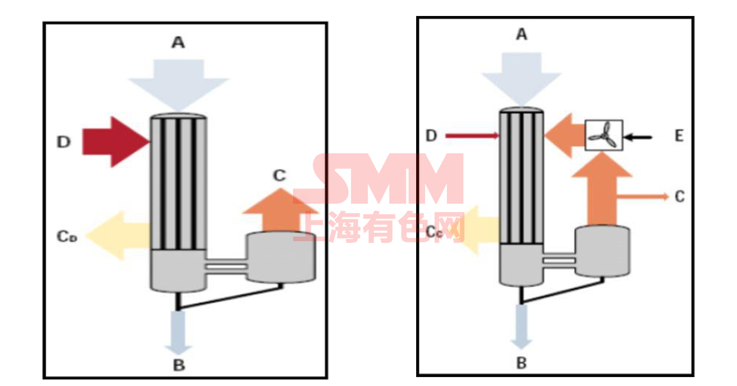
MVR is the abbreviation of mechanical steam recompression technology (mechanical vapor recompression). It is an energy-saving technology that uses the secondary steam produced by the evaporation system to do work by the steam compressor to enhance the heat energy of the secondary steam, so as to circulate the heat supply to the evaporation system, thus reducing the demand for external energy.
Advantages:
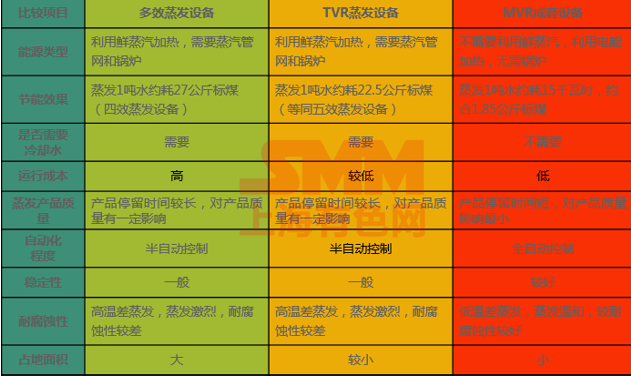
The operation cost is low, the evaporation of the product is mild because of the low temperature difference, the residence time of the product is short, the process is simple, the practicability is strong, the degree of automation is high, and the operation cost is low.
Energy-saving evaporation technology
Evaporation, distillation, crystallization and drying devices are all high energy consumption, and the operating cost of these devices mainly depends on energy consumption, so the reduction and optimization of unit energy consumption is the most important. There are three main evaporation technologies that can minimize unit energy consumption, which can be applied alone or in combination.
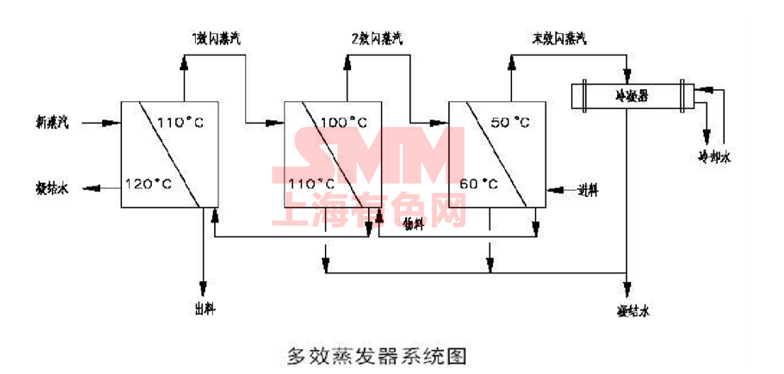
Multi-effect evaporation system
The difference between MVR and Multi-effect evaporation
Comparison of energy-saving evaporation technologies
How MVR evaporator works:
Compared with the traditional evaporator, the MVR evaporator can reuse the secondary steam by compression to replace the fresh steam, which not only saves fresh steam, but also completely abandons the cooling tower, greatly reduces the operating cost, and truly achieves environmental protection, energy saving and water saving!
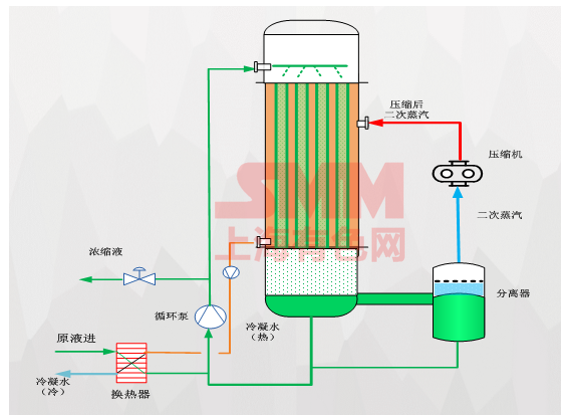
The core of energy saving in MVR technology is to realize cyclic evaporation by raising its temperature as a heat source instead of fresh steam.
It should be noted that the MVR evaporation system is mainly divided into three parts, namely, preheating, steam recompression and evaporator. The source of heat in the MVR system is the steam compressor. At present, the more commonly used in the market are: domestic centrifugal compressors and imported centrifugal fans. Imported centrifugal fan, single temperature rise of 8-9 degrees, low speed of impeller, generally 3000-5000rpm; 2507 material impeller. Domestic centrifugal compressor, a single temperature rise of 20 degrees, high speed, generally 16000rpm, using TC4 impeller.
MVR system-types of commonly used evaporators:
Falling film evaporator, forced circulation evaporator and plate evaporator
Practical Application of MVR evaporation Crystallization Technology in Lithium Electric Industry
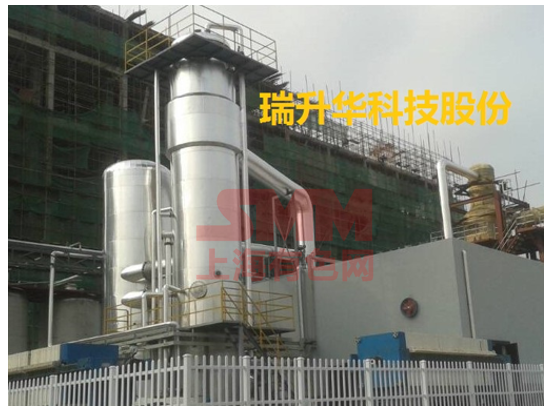
MVR evaporation crystallization of lithium sulfate and sodium sulfate (Jiangte Silver Lithium, Zhiyuan Lithium Industry, Ganfeng Lithium Industry, Xinfeng Lithium Industry)
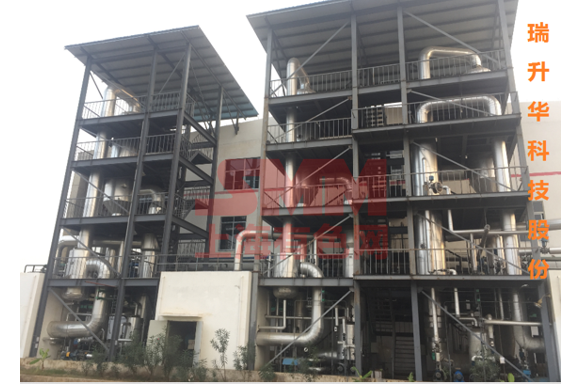
MVR evaporation crystallization of lithium sulfate and sodium sulfate (Jiangte Silver Lithium, Zhiyuan Lithium Industry, Ganfeng Lithium Industry, Xinfeng Lithium Industry)